
ASTM F963 covers the safety requirements for toys intended for children under 14, but its practical scope for your shipment is defined by the current edition incorporated into U.S. regulation (16 CFR Part 1250) and by your product's age grade, configuration, and destination market. You must map your SKU to the applicable standard edition, require a test report that names the product configuration and age grade, and verify that any certificate—like the Children's Product Certificate (CPC)—is SKU-specific, not a blanket factory approval. This article gives you a decision framework: what the standard covers, what evidence to demand, and how to avoid compliance gaps when sourcing from overseas suppliers.
Key Takeaways
- ASTM F963 applies to toys for children under 14, but U.S. federal law requires third-party testing and a CPC only for toys intended for children 12 and under; verify your product's age grade before assuming full testing obligations.
- The mandatory edition is ASTM F963-23, effective April 20, 2024; your supplier's test report must cite this edition, not an older one, and you should confirm the current version on the CPSC website.
- A Children's Product Certificate (CPC) must include seven elements, must be based on testing at a CPSC-accepted lab, and is product-specific—it does not certify a factory as a whole.
- Only specific sections of ASTM F963 require third-party testing, but certification covers all applicable sections; you must identify which sections apply to your toy rather than assuming a one-size-fits-all test.
- Additional CPSIA requirements—such as lead limits (100 ppm substrates, 90 ppm paint), phthalates (0.1%), and tracking labels—are separate from ASTM F963 and must be verified independently.
What Does ASTM F963 Actually Cover?
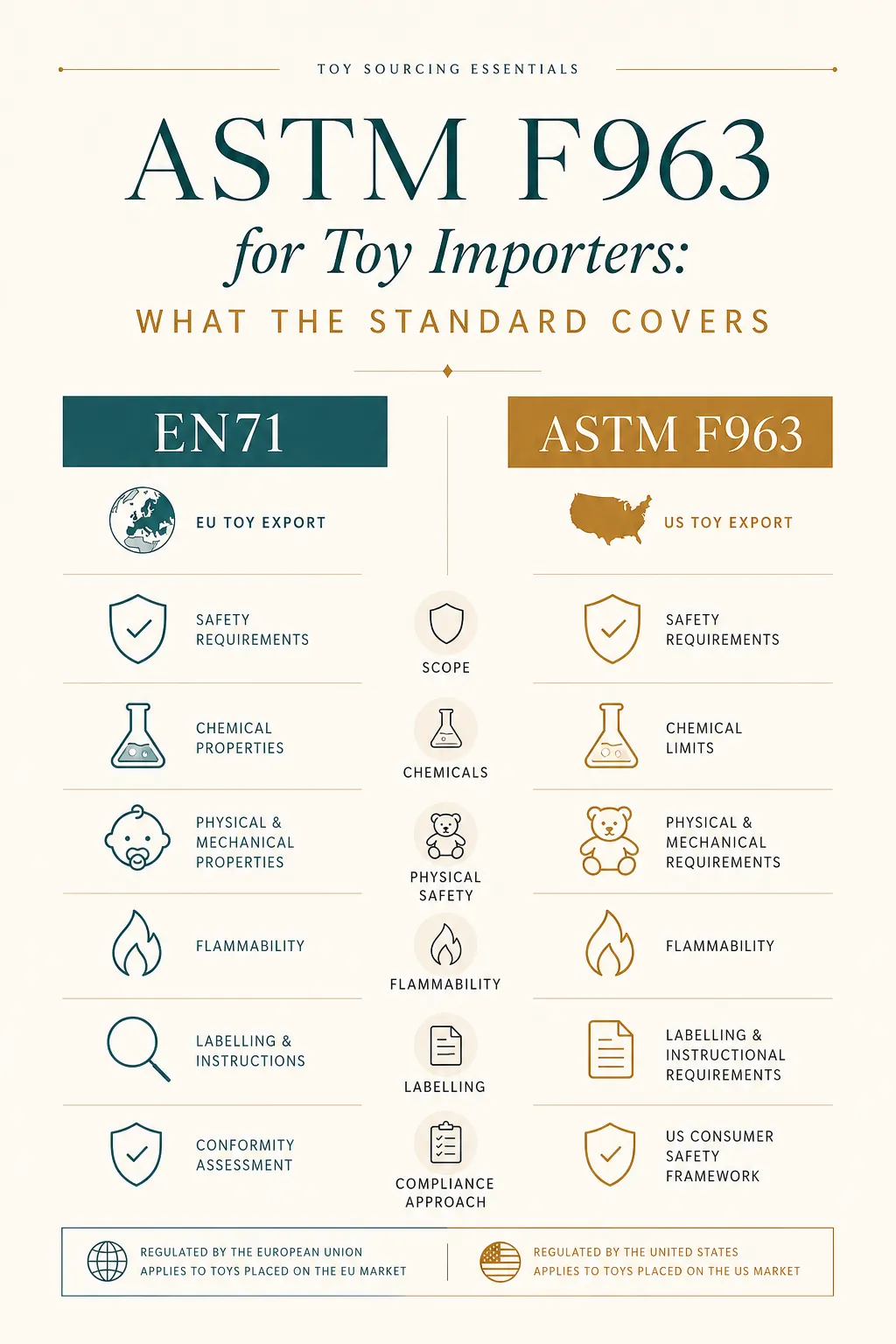
ASTM F963 is a comprehensive safety standard for toys, covering mechanical, physical, chemical, and flammability hazards, as well as labeling and battery safety. It is written for products intended for children under 14, but not every section applies to every toy. For example, a plush toy may not need battery compartment testing, while an electronic toy will.
Your job is to identify which sections apply to your specific product. CPSC guidance says that manufacturers and importers must determine the applicable sections, and only those listed in 16 CFR § 1112.15(b)(32) require third-party testing by a CPSC-accepted lab. However, your CPC must certify compliance with all applicable sections, even those not subject to third-party testing.
A test report that only covers mechanical hazards is not enough if your toy contains batteries or accessible plastic components. You need a report that maps to the specific hazards inherent in your product's design and materials.
Why the Edition and Age Grade Matter More Than You Think
The standard is updated periodically, and the mandatory version changes over time. As of April 20, 2024, ASTM F963-23 is the current mandatory edition in the U.S., replacing F963-17. This update introduced stricter requirements for battery accessibility (requiring a common household tool like a screwdriver), acoustics, and heavy metals.
If your supplier provides a test report citing an older edition, it may not be valid for customs clearance or marketplace compliance. Always check the current regulation (16 CFR Part 1250) and confirm the edition with your lab or supplier.
Age grade is critical. The standard covers toys for children under 14, but federal law only requires third-party testing and certification for toys intended for children 12 and under. That means a toy marketed for ages 13-14 may not require full testing, but you must be certain about the age grade and its regulatory implications. Small parts, for example, are banned for toys intended for children under 3, so a toy with detachable parts must be age-graded accordingly.
ASTM F963 vs. EU Toy Safety Requirements
| Regulatory basis | US: 16 CFR Part 1250 incorporates ASTM F963; EU: Toy Safety Directive 2009/48/EC |
|---|---|
| Age scope | US: under 14 for the standard, under 12 for mandatory testing/certification; EU: under 14 |
| Testing requirement | US: third-party testing at CPSC-accepted lab for specific sections; EU: conformity assessment by notified body for some categories |
| Certification document | US: Children's Product Certificate (CPC); EU: EU Declaration of Conformity (DoC) |
| Marking | US: tracking label, cautionary labeling; EU: CE marking |
| Chemical limits | US: lead 100 ppm, phthalates 0.1%; EU: different limits under the Directive, e.g., for heavy metals |
| Separate instruments | The EU GPSR (2023/988) is a separate legal instrument from the Toy Safety Directive; do not mix their deadlines or scope. |
What Evidence Should You Demand from Your Supplier?
When sourcing toys, request specific evidence, not generic claims. Use this minimum checklist:
1. A test report that identifies the product configuration, age grade, and standard edition (e.g., ASTM F963-23). The report must be from a CPSC-accepted laboratory.
2. A Children's Product Certificate (CPC) that includes the seven required elements: product identification, citation to each applicable safety rule, manufacturer/importer identification, contact info for record keeper, date and place of manufacture, date(s) and place(s) of testing, and identification of the third-party lab.
3. If your toy has accessible plasticized components, ask for a phthalate test that covers those components and the current restricted list for the target market. For electronic toys, request RoHS evidence covering the electrical and electronic components and the current restricted-substance list.
4. Confirm that tracking labels are permanent and support product identification, as required by CPSC guidance.
5. Verify that the small parts assessment covers assemblies, detachable accessories, and packaging components, not just the main body.
Remember: a CPC is product-specific. It is not a 'factory certificate.' If a supplier says 'we have ASTM certification,' ask for the exact report and CPC for your SKU.
How to Build a Compliance-Ready RFQ
Put compliance requirements into your RFQ from the start. Your toy RFQ should state the destination market, age grade, materials and colors, packaging language, requested tests, sample policy, tooling terms, and the requested trade term. Specifically, include:
- Destination market: because age grading, warnings, testing, and marking vary by jurisdiction (e.g., US vs EU).
- Standard edition: e.g., 'ASTM F963-23' for the US.
- Test matrix: identify the market, standard edition, product configuration, age grade, and laboratory route (e.g., CPSC-accepted lab, or a specific notified body for EU).
- Required documentation: request a CPC and test report for your exact SKU, not a generic report.
By specifying these details, you signal to the supplier that you understand compliance and expect SKU-specific evidence. This reduces the risk of receiving a 'certificate' that doesn't cover your product.
FAQ
What is the difference between ASTM F963 and EN71?
ASTM F963 is the U.S. toy safety standard, while EN71 is the European standard. They cover similar hazards but have different test methods, limits, and labeling requirements. A product that passes EN71 may not pass ASTM F963, and vice versa. Always test to the standard required by your destination market.
Do I need a CPC for every toy I import to the U.S.?
Yes, for toys intended for children 12 and under, you need a Children's Product Certificate (CPC) based on testing at a CPSC-accepted lab. The CPC must be product-specific and include the seven required elements. Even if a product is exempt from third-party testing, you still need a CPC citing the exemption.
What happens if my supplier's test report cites an older edition like ASTM F963-17?
If your product is exported to the U.S., the test report must cite the current mandatory edition (currently ASTM F963-23). An older edition may not be accepted by customs or marketplaces. Ask your supplier to re-test to the current edition or confirm the report's validity with a CPSC-accepted lab.
Can I use component-level testing for chemicals to cut costs?
Component-level testing for chemicals (e.g., paints, plastics) can reduce costs for shared raw materials, but it cannot replace finished-product mechanical testing. For mechanical hazards, you need testing on the final product. Confirm with your lab which components can be tested separately and what must be tested on the finished toy.
What are the CPSIA lead and phthalate limits I should verify?
Under CPSIA, the lead limit for accessible substrates is 100 ppm, and for paint or surface coatings it's 90 ppm. Phthalates are restricted to 0.1% (1000 ppm) in accessible plasticized components. These limits are separate from ASTM F963 and must be verified independently for your product.
What is the eFiling requirement for certificates starting July 8, 2026?
Starting July 8, 2026, importers must electronically file certificates of compliance with U.S. Customs and Border Protection (CBP) via a Partner Government Agency (PGA) Message Set. This applies to CPCs. Prepare your documentation and systems in advance to avoid customs delays.
Sources
Request Certificates
If you're sourcing toys and need to verify compliance, ask your supplier for the specific test report and CPC for your SKU. We can help you evaluate the evidence. Request our compliance checklist and discuss your destination market requirements.