
Key Takeaways for a New Toy Retail Line
- Scope the assortment before you contact suppliers: List target SKUs, retail price points, and volume per SKU per order cycle first. A supplier MOQ of 35 pieces per SKU is common for factory-direct lines, so a shortlist that meets that threshold prevents wasted RFQ rounds.
- A photo is not a production standard: The sealed golden sample, labeled with tool number and revision, is the QC reference. Bulk is compared to that physical piece for color, fit, flash, and function. Buyers who approve only a photo pay for it on the second lot.
- One certificate does not cover every market or lot: UKCA and a VOC file on an electric toy are different papers, and a type-test report does not automatically cover a later production lot. Match report SKU, materials, colors, and production date to the PO; paperwork that does not match the lot is not paperwork.
- Line clearance is a real checkpoint, not a formality: Before your run starts, ask for a signed record confirming the previous SKU's labels, colors, and work instructions were removed. A mixed label reaching a retailer is the failure mode that makes line clearance worth the boring paperwork.
- Set a reorder trigger, not a stockout panic: A factory lead time of 25–35 days means your reorder point must account for production plus transit. Sellers who reorder every 6–8 weeks on impulse toys treat 'when is the next batch?' as the planning question, not 'do you have stock?'
What should your assortment and RFQ include before you ask for prices?
Your RFQ should open with the SKU list and the retail price band for each item. A toy quote only becomes comparable when it separates tooling, samples, production parts, decoration, testing, packaging, freight, and taxes. If a supplier sends a single lump-sum number, ask them to break it out. The line items are what let you compare two factories honestly.
For each SKU, note the target color in Pantone terms, the packaging type (a kraft box with a sticker is a different cost and spec than a printed window box), and the logo placement. Put all of that in the RFQ so the supplier prices the same thing you intend to sell. A vague RFQ produces a vague quote, and the difference shows up later as a change order or a surprise tooling fee.
Three product profiles give a sense of the range: a plastic electric learning table with music (MOQ around 240 pieces), a multi-functional plastic fidget and battle-table playset (MOQ around 36 pieces), and a 163-piece building block set with a draw table (MOQ around 12 pieces). The MOQ spread shows why assortment scoping matters — a low-MOQ impulse item and a high-MOQ electronic item need different order cycles and different cash commitments.
Which supplier channel fits your risk and cash position?
Factory-direct in China suits a buyer with defined SKUs, custom branding needs, and tolerance for a 25–35 day production lead time. You get clearer control over tooling, decoration, and QC checkpoints, but you carry more project-management work and usually need to commit to larger quantities per SKU.
A trading company or distributor makes sense when you want mixed SKUs in smaller quantities, faster consolidation, or you are testing a new line before committing to deeper stock. The trade-off is less direct control over the production line and an extra margin layer. The verification burden does not disappear — you still need lot-matched paperwork and a physical sample reference.
Online B2B marketplaces sit in between. They aggregate many factories and offer buyer-protection mechanisms, but the platform does not replace your own QC process. Treat a marketplace listing as the start of the same evidence workflow, not as a shortcut past it.
Which compliance documents apply, and how do you match them to your lot?
Different markets and different toy categories need different papers. For the EU, mechanical and chemical safety typically falls under EN 71, while electric toys usually need EN IEC 62115 in addition. For the US, ASTM F963 is the standard consumer safety specification for toys. These are separate tests with separate reports, and a single certificate rarely covers all of them.
The critical distinction is between a type-test report and a shipment certificate. A type-test or golden-sample report says the design passed testing at a point in time. It does not automatically cover a later production lot if the SKU, materials, colors, or production date differ. Match the report's SKU, materials, colors, and production date/cohort to the PO. If they do not line up, the report is not evidence for that shipment.
The same lot-matching logic applies to market-specific files. UKCA and a VOC file on an electric bubble machine are different papers, and a buyer who tries to use one certificate for both will find the paperwork fails when it is checked against the lot. Map each SKU to its destination market and list the specific document that applies. If the supplier cannot map the file to the lot number, treat that as an open question, not a pass.
Beyond product safety, packaging has its own review. EU packaging rules cover waste prevention and management, so packaging design and waste data need a separate review from CE marking. Do not fold packaging compliance into the product certificate.
How do you verify production before your batch is made?
Ask for a line clearance record before production starts. The record should confirm that the previous SKU's labels, colors, and work instructions were removed from the line. A new SKU starting with the last SKU's labels still in the hopper is a real failure mode, and it only becomes visible when a mixed label reaches a retailer. Line clearance is boring until that happens.
Link the drawing or 3D-model revision to the tooling, the first article inspection, the test sample, and the production order. This revision control prevents an old file from silently returning to use. If a supplier cannot show which revision the tooling was built from, ask for the document trail before you approve the run.
What should an inspection report actually compare against?
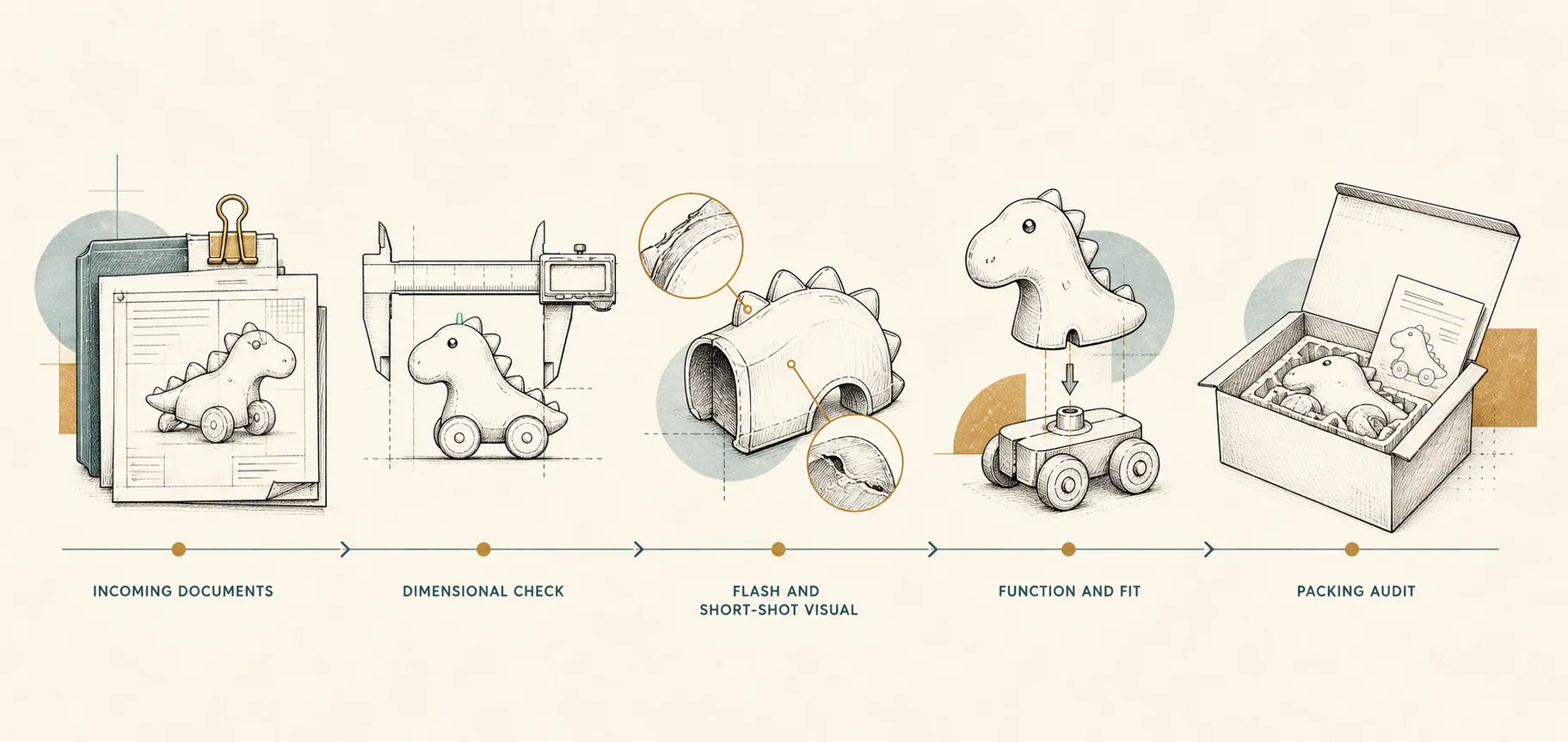
Schedule the inspection against the sealed golden sample, not against a photo and not against the fair booth sample. Define the checkpoints in advance: color, fit, flash, function, packaging, and labeling. The inspection report should reference the golden sample by model and lot, and flag any deviation from it.
AQL (Acceptable Quality Limit) is the common sampling framework, defined under ISO 2859-1. Importers typically set different AQL levels for critical, major, and minor defects. The inspection level (I, II, III for general, S-1 through S-4 for special) and the AQL value together determine how many units are sampled and how many defects trigger a reject. There is no universal AQL number for toys — it is negotiated between buyer and supplier before the batch ships. Ask your supplier which AQL standard they apply per SKU, and put it in the PO.
How do you plan shipping, lead time, and reorders so you do not run dry?
A factory lead time of 25–35 days is a realistic planning assumption for a factory-direct order. That is production time, not transit. Add ocean or air freight, customs, and any inspection days to get your true landed lead time. Your reorder point should be the sell-through rate multiplied by that total lead time, plus a safety buffer.
On the reorder side, treat the question as 'when is the next batch of SKU #03?' rather than 'do you have stock?' Sellers who reorder on a fixed cadence — every 6–8 weeks for impulse toys — avoid both stockouts on viral designs and the margin loss of emergency air freight. For seasonal lines, align the order calendar so the production slot and transit window land before the selling season starts.
Worked example (illustrative, not a real shipment): a buyer orders 1,000 pieces of a plastic building block set for a spring launch. The factory lead time is 30 days, ocean transit to the West Coast US is 20 days, and the buyer adds 5 days for inspection and customs. Total landed lead time is 55 days. If the buyer expects to sell 400 pieces in the first month, the reorder trigger is when inventory drops below roughly 400 pieces, not when the shelf is empty. Without the buffer, the buyer faces either a stockout or a premium air-freight bill.
How do you keep lot-level evidence organized for each SKU?
Create a folder per lot, not per product line. Store the PO, the golden sample reference (model and lot), the line clearance record, the inspection report, and the relevant compliance documents (test report, VOC file, or certificate) in that folder. The rule is simple: paperwork that does not match the lot is not paperwork.
If a file is missing, it is an open question, not an assumption. A buyer who accepts a type-test report as covering a later lot without checking the SKU, materials, and production date is carrying risk that the certificate does not actually cover. The lot-level folder makes that gap visible before the shipment leaves the factory, not after it arrives at the retailer.
Sourcing channel comparison for a new toy retail line
| Factory-direct (China) | MOQ per SKU: varies by item (35–240 pieces observed); Lead time: 25–35 days production; Control: highest on tooling and QC; Best for: custom branding, larger per-SKU volume; Trade-off: more project management, deeper cash commitment per SKU |
|---|---|
| Trading company / distributor | MOQ: typically lower, mixed-SKU friendly; Lead time: varies by consolidation; Control: indirect on production line; Best for: testing a line with smaller quantities; Trade-off: extra margin layer, less direct QC visibility |
| Online B2B marketplace | MOQ: varies by listing; Lead time: varies by seller; Control: platform protection but no QC substitution; Best for: quick comparison of multiple factories; Trade-off: you still run your own verification workflow |
| Evidence requirement (all channels) | Golden sample labeled with tool/revision, line clearance record, lot-matched test report or certificate, inspection report referencing the physical sample. Missing file = open question, not a pass. |
What to ask suppliers before you place the order
| Compliance mapping | Which specific certificate or file applies to this lot for my destination market, and can you map the document to the lot number? For electric toys, confirm whether EN IEC 62115 applies in addition to EN 71 or ASTM F963. |
|---|---|
| Golden sample | Will you ship a sealed golden sample labeled with tool number and revision before bulk production, and will you compare bulk to that physical sample during inspection? |
| Line clearance | Can you provide a signed line clearance record confirming the previous SKU's labels, colors, and work instructions were removed before our run? |
| Packaging spec | What is the exact packaging spec (material, size, sticker placement, Pantone reference) for our SKU, and is it itemized in the quote separately from production parts? |
| AQL standard | Which AQL standard and inspection level do you apply per SKU, and is it written into the PO? Confirm the critical/major/minor defect limits before the batch ships. |
| Reorder lead time | What is the lead time for a reorder after the first batch, and how do you handle stockouts on fast-moving designs? Is the reorder slot reserved, or does it go back into the queue? |
FAQ
What MOQ should I expect for a new toy SKU from a China factory?
MOQs vary by product type. Observed examples range from around 12 pieces for a simple building block set to 36 for a multi-functional playset and 240 for an electric learning table. Confirm the MOQ per SKU in writing before you build your assortment plan.
How long does a factory-direct toy order take from PO to delivery?
Production lead time is commonly 25–35 days for factory-direct orders. Add ocean or air transit, inspection days, and customs clearance to get your true landed lead time, which is what your reorder point should be based on.
Is a test report enough to clear my shipment through customs?
A type-test or golden-sample report does not automatically cover a later production lot. Match the report's SKU, materials, colors, and production date to the PO. If they do not line up, the report is not valid evidence for that shipment.
Can I use one certificate for both UK and EU toy compliance?
Not necessarily. UKCA and EU CE marking are separate regimes, and a VOC file is a different document again. Map each SKU to its destination market and confirm which specific document applies. Paperwork that does not match the lot is not paperwork.
What is the most reliable QC reference if I cannot visit the factory?
The sealed golden sample, labeled with tool number and revision, is the QC reference. Have it shipped before bulk production, and require the inspection report to compare bulk against that physical sample for color, fit, flash, and function.
How do I avoid a stockout on a viral toy design?
Set a reorder trigger based on sell-through rate multiplied by total landed lead time, plus a safety buffer. Treat the planning question as 'when is the next batch?' rather than 'do you have stock?' A 25–35 day production lead time means the reorder decision comes before the shelf looks empty.
Sources
Turn this checklist into a working RFQ
You now have the evidence workflow: scope the assortment, itemize the RFQ, approve a sealed golden sample, verify line clearance, match paperwork to the lot, inspect against the physical reference, and set a reorder trigger. The next step is turning it into a live RFQ for your shortlisted SKUs.
Request a quote with the itemized breakdown — tooling, samples, production parts, decoration, testing, packaging, freight, and taxes — so you can compare suppliers on the same basis. Ask the supplier to confirm the MOQ per SKU, the AQL standard, and the lead time in writing before you commit.