
The single most important step before any toy production run is to freeze the design and lock the evidence trail in writing: tooling ownership, compliance files, sealed samples, and the inspection plan all need to be confirmed before the factory starts. Without that frozen record, you are approving a moving target, and the cost of a late change lands on your container. This guide gives you a repeatable release-gate checklist that ties commercial tradeoffs to product, compliance, packaging, QC, and supplier evidence, so you can make a defensible go/no-go decision.
Key Takeaways
- Freeze the design before tool release: a design freeze before production-tool release reduces unapproved changes to geometry, material, markings, and test evidence.
- Tooling ownership is a contract clause, not a handshake: state the fee, who owns the tool after payment, storage years, and what happens if the tool sits idle.
- Map every compliance file to the exact market and lot: a type-test or golden-sample report does not automatically cover a later production lot; match report SKU, materials, colors, and production date/cohort to the PO.
- The sealed golden sample is the standard, not a photo: emails and fair photos lie; compare bulk to the physical piece with tool number and revision.
- Set the AQL and defect classes in the PO, not in a blog: the inspection plan must be written into the PO, and failed lots are isolated, recorded, and released only after rework.
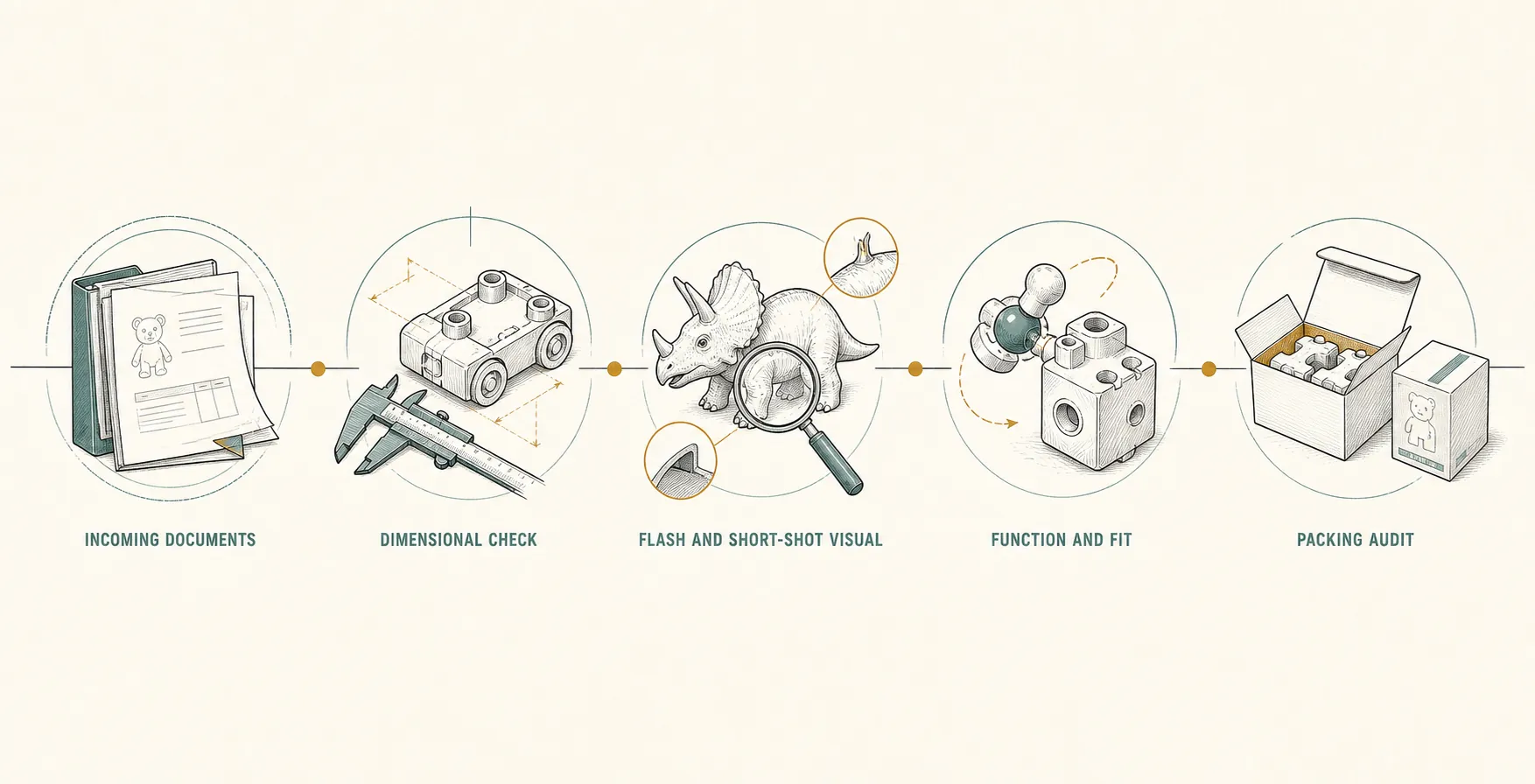
How Do You Define the Release Gate Before Production?
A release gate is a formal checkpoint that must be passed before the factory is authorized to start production. It is not a casual email approval; it is a documented decision point where the buyer and supplier confirm that all prerequisites are met. The gate typically covers four areas: design and tooling, compliance and documentation, physical sample approval, and the production and inspection plan.
The release gate is your last chance to influence the product before it becomes expensive to change. After the mold is cut or the first batch is molded, changes to geometry, material, or markings require rework, new tooling, or new test evidence, all of which add cost and lead time. A design freeze before production-tool release is the first line of defense.
What Must Be Frozen in the Tooling Contract?
The tooling contract is the foundation of your entire order, and it must be a document, not a handshake. Before the factory starts, confirm that the contract states: the tooling fee, who owns the tool after payment, the storage period (how many years the factory will keep it if you do not reorder), and what happens if the tool sits idle. A buyer once paid a tooling fee and later discovered the contract had not frozen storage years or release conditions, leaving them without clear recourse.
Ask the factory directly: "Who owns the tool after I pay the fee, and how long do you store it if I don't reorder?" Also ask what happens if the tool is idle for more than a year, and whether you can request the tool or its mold to be transferred. Get these answers in writing before you sign.
How Do You Map Compliance Files to the Exact Market and Lot?
Compliance is not a single certificate; it is a set of files that must match the specific product, market, and production lot. A UKCA marking and a VOC (volatile organic compounds) file on an electric bubble machine are different papers, and one cannot be used for both. A buyer once tried to use one certificate for two different compliance requirements, and the paperwork did not match the lot.
Before production, ask the factory to list every required file per destination market. For toys sold in the U.S., the CPSC requires that all toys intended for children 12 and under be third-party tested by a CPSC-accepted lab and certified via a Children's Product Certificate (CPC). The current standard is ASTM F963-23 (effective April 20, 2024), but only specific sections require third-party testing; the rest must still be certified. For the EU, the GPSR and Toy Safety Directive impose separate requirements, and the Digital Product Passport is a different regime with its own timeline. Map each file to the SKU, materials, colors, and production date/cohort of your PO.
Why Is the Sealed Golden Sample Non-Negotiable?
The sealed golden sample is the physical benchmark that ends colour fights and dimension disputes. A booth sample at a fair is often a hero unit, and fair lighting lies. A photo of a sample is not the production standard; the revision card with tool number and revision is. Emails do not end arguments; the physical piece on the QC shelf does.
Before the factory starts, require a sealed golden sample that has been approved by you and stored at the factory with the tool number and revision clearly labelled. Compare bulk production to that sample for colour, fit, flash, and function. Buyers who approve only a photo often pay for it on the second lot. Ask the factory: "Can you show me the sealed golden sample with the tool number and revision before you start?"
What Is Line Clearance and Why Does It Matter?
Line clearance is the procedure that ensures the production line is free of any remnants of the previous SKU before your order starts. This includes labels, colours, work instructions, and any other material that could be mixed into your product. A new SKU once started with the last SKU's labels still in the hopper, and a mixed label reached a retailer. Line clearance is boring until it fails.
Put a line-clearance check in the PO as a release gate. Specify that the factory must clear labels, colours, and work instructions from the previous SKU, and ask to see the checklist. Ask: "What is your line-clearance procedure between SKUs, and can I see the checklist?"
How Do You Set the Inspection Plan and AQL?
The AQL (Acceptable Quality Limit) number and defect classes must be agreed upon and written into the PO, not pulled from a blog or a catalogue sentence. The factory should not invent an AQL number in a blog; on the floor, a failed lot is isolated, the defect class is recorded, and release happens only after rework. Buyers who want a number get it from the agreed inspection plan on the PO.
Ask the factory: "What AQL and defect classes are in my PO? Can you confirm the inspection plan in writing?" Also confirm the inspection level (general or special) and the sample size code, which depend on the lot size and the inspection level chosen. The AQL value (e.g., 1.0, 2.5) determines the maximum number of defects allowed for acceptance.
What Packaging and QC Photo Evidence Do You Need Before Shipment?
Require QC photos before shipment and verify that the packaging matches the approved sample. Clear blister packaging, for example, must show the product correctly, with the right labels and markings. The QC photo should be taken against a neutral background and show the product, packaging, and any relevant marks.
Ask the factory: "When will you send QC photos, and what packaging spec will they verify against?" Also confirm that the QC photo schedule is agreed upon in the PO, so you are not waiting for photos after the container has sailed.
Release-Gate Checklist: What to Check and Red Flags
| Tooling contract | Fee, ownership, storage period, idle-tool clause | Red flag: verbal promises or no written idle-tool policy |
|---|---|
| Compliance mapping | List of files per market and lot | Red flag: one certificate claimed for multiple markets or lots |
| Sealed golden sample | Physical sample with tool number and revision | Red flag: only a photo approved, no physical reference |
| Line clearance | Checklist that clears labels, colours, and instructions | Red flag: no procedure or refusal to show checklist |
| Inspection plan | AQL and defect classes written in PO | Red flag: AQL not specified or only verbal |
| QC photos | Schedule and packaging spec for photo verification | Red flag: no agreed photo timing or format |
Worked Example (Illustrative, Not a Real Shipment)
Consider a mixed-container importer in Lima planning a 40HQ load. The order includes a plastic building block set (MOQ 35) as filler, plus outdoor goods. The buyer must confirm the CBM per unit and per MOQ fits the container plan, and that the product's branding supports the retailer's storytelling. The release gate would include: tooling contract signed, compliance file mapped to the Peruvian market (or the destination market), sealed golden sample with tool number, line-clearance checklist confirmed, AQL written into the PO, and QC photo schedule agreed. If any step is missing, the gate fails and production does not start.
This step is where a container could be held: if the compliance file does not match the lot, or the packaging spec is not verified, the shipment could be delayed at customs. The release gate is your opportunity to catch these issues before they cost you a container.
What to Ask Suppliers (RFQ Checklist)
Before you sign, ask these seven questions in writing:
1. Who owns the tool after I pay the fee, and how long do you store it if I don't reorder?
2. Which certificate covers which market and which lot? Can you map each file to my destination?
3. What is the CBM per unit and per MOQ for this SKU, and how does it fit a 20GP/40HQ?
4. Can you show me the sealed golden sample with the tool number and revision before you start?
5. What is your line-clearance procedure between SKUs, and can I see the checklist?
6. What AQL and defect classes are in my PO? Can you confirm the inspection plan in writing?
7. When will you send QC photos, and what packaging spec will they verify against?
FAQ
Who owns the tool after I pay the tooling fee?
Ownership must be defined in the contract. State who owns the tool after payment, the storage period, and what happens if the tool sits idle. If the contract is silent, you may not have rights to it.
Can I use one compliance certificate for multiple markets?
No. Each market has its own requirements (e.g., UKCA vs. VOC). A file must match the specific product, lot, and destination. Ask the factory to map each file to your markets.
What is the AQL number for my order?
The AQL number must be agreed between you and the supplier and written into the PO. Common values are 1.0, 2.5, or 4.0, but the specific number depends on your risk tolerance and product type. Confirm it with the factory before production.
Why do I need a sealed golden sample?
The sealed sample is the benchmark for colour, fit, and function. Photos can mislead due to lighting. The physical sample with tool number and revision is the standard for bulk comparison.
What is line clearance and why is it critical?
Line clearance removes remnants of the previous SKU (labels, colours, instructions) before your production starts. Without it, mixed labels can reach retailers, causing recalls. Include a line-clearance check in the PO.
What happens if my shipment fails final inspection?
The failed lot is isolated, the defect class is recorded, and rework is required before release. Final inspection must verify product, packaging, markings, quantity, documents, and test status before shipment release.
Sources
Request a Quote
Ready to move your toy order forward with a release-gate checklist that protects your container? Get a quote from a factory that documents tooling ownership, seals golden samples, and writes the inspection plan into the PO. Send your product spec and target market to start the conversation.