
If you buy toys wholesale, your order plan needs three numbers that actually fit your sales cycle: the supplier's minimum order quantity (MOQ), the true lead time from order to delivery, and a reorder trigger based on sell-through rather than stock availability. Start by asking the supplier three questions: What is the MOQ per SKU? Does the lead time include production, packaging, and peak-season buffers? And what is your line-clearance procedure between different products? These answers shape your cash flow, storage needs, and ability to restock before you run out.
Key Takeaways
- Set your reorder trigger on units sold, not on stock levels. For example, reorder when you have sold about 60% of your current batch, and account for the supplier's lead time so new stock arrives before you hit zero.
- Separate lead time into tooling, sampling, testing, production, packaging, and shipping. A single total number hides which step causes delays; ask the supplier to break it down.
- Verify product compliance before you commit to a MOQ. Button-cell toys must have secure compartments (screw closure, tool access) and proper warnings; a cute electronic that opens with fingernails should not ship.
- Use a sample revision card, not a trade-show photo, as your production standard. Fair lighting can mislead; a labeled revision card tied to the tool number prevents costly mismatches.
- Ask the supplier for their line-clearance log. A new SKU running with the previous SKU's labels in the hopper can send a mixed-label batch to a retailer, so confirm the procedure before you order.
What Changed This Year in Toy Order Planning?
In 2026, toy buyers face tighter compliance scrutiny and longer peak-season lead times. Regulatory attention on button-cell battery access has intensified, especially for products sold in the US, where rules require secure compartments and clear warnings. The EU's new toy Regulation also emphasizes that warnings must be legible and not contradict intended use. These changes mean that your order plan must include compliance verification as an early gate, not an afterthought. If you are importing toys with electronics or small parts, confirm the compartment design and warning labels before you calculate MOQ or lead time.
How to Define Your Order Scenario and Commercial Constraint
Before you talk MOQ, know your sales channel and demand pattern. A Mercado Libre seller in Mexico buying party favors may reorder every six to eight weeks, needing small, frequent batches to avoid stockouts on viral designs. A container importer filling a 20GP or 40HQ needs high-turnover filler to complete cubic meters, often with less frequent but larger orders. Map your scenario to your cash cycle: How fast do you sell a batch? What is your storage cost? What is your reorder lead time? If your product is seasonal, like summer water tables or holiday electronics, your order window is fixed, and a missed vessel in September can mean no stock for the peak.
Why MOQ Matters — and How to Calculate a Sensible Order Size
MOQ is the smallest quantity a supplier will accept per order, set to cover production setup costs. A simple MOQ is a fixed number per product; a complex one may depend on product mix, delivery location, or total spend. For toy buyers, the trade-off is between per-unit cost and overstocking risk. A high MOQ may lower your unit price but tie up working capital and warehouse space. To find your optimal order size, calculate your economic order quantity (EOQ): the square root of (2 × annual demand × ordering cost) divided by (unit cost × annual holding cost percentage). Holding cost typically runs 20–30% of inventory value. For example, if your annual demand is 5,000 units, ordering cost is $750, unit cost is $12, and holding cost is 25%, your EOQ is about 1,600 units. Round up to full cartons. If freight rates rise, your ordering cost increases, and your EOQ shifts higher — recalculate quarterly.
What Lead Time Really Includes — and How to Plan for Peak Season
A lead time of 25–35 days is meaningless without knowing which steps are inside it. Ask your supplier to break it down: tooling (if new), first sample, testing, production, packaging, and shipping. Each step has a different dependency. For example, a color change during peak season can add days or weeks if the mold must be swapped. A verbal 'quick colour change' in September has missed more vessels than steel problems. Get the freeze date — the last day you can change colors or packaging without delaying production — and the change-over hours in writing. Add a buffer for peak season, when factories run at capacity. If your product needs certification testing, factor in lab time; a type-test report for one sample does not automatically cover a later production lot. Match the report's SKU, materials, colors, and production date to your PO.
Compliance and Packaging Gates Before You Commit to MOQ
Two gates come before any MOQ math. Gate one: product compliance. For button-cell toys, verify the compartment is secured with screws, requires a tool to open, and carries the required warning. A cute electronic that opens with fingernails does not ship. In the US, you need a Children's Product Certificate (CPC) issued by the responsible manufacturer or importer, identifying the rules supported by testing evidence. For the EU, warnings must be intelligible and visible. Gate two: packaging and labeling. Confirm the label matches your SKU exactly. A line clearance failure — when a new SKU starts with the previous SKU's labels still in the hopper — can send a mixed-label batch to a retailer. Ask for the supplier's line-clearance log for the last three runs.
Order Planning Steps at a Glance
| Step | What to check |
|---|---|
| Define scenario | Channel demand, cash cycle, storage cost |
| Compliance gate | Button-cell compartment, warnings, CPC, EU labeling |
| Calculate MOQ | EOQ formula, holding cost %, full-carton rounding |
| Plan lead time | Break down tooling, sample, testing, production, packaging, shipping |
| Sample approval | Revision card with tool number and revision, not a photo |
| QC checkpoints | Line clearance, in-line inspection, pre-shipment against sample |
| Set reorder rule | Trigger on sell-through (e.g., 60% sold) with lead-time buffer |
How to Vet a Supplier for MOQ and Lead Time Realism
A supplier's MOQ and lead time are only credible if they can show you the mechanics behind them. Ask targeted questions: What is your line-clearance procedure between SKUs, and can you show a clearance log? For button-cell toys, what is the screw torque spec and tool-access test method? Can you share the compartment test report? What is the freeze date for a color change during peak season, and how many hours does a change-over take? Can you provide a revision card for the sample that matches the production tool number and revision? What is your AQL level and inspection standard for pre-shipment checks? Do you have a button-cell warning label template that meets US regulations? What is your actual monthly capacity for my order window? And does your quoted lead time include peak-season buffer, or is it a non-peak figure? If a supplier hesitates on any of these, treat it as a red flag.
How to Use Samples and Revision Cards to Lock the Production Standard
A booth sample at a trade fair is often a hero unit, not a production standard. Fair lighting can make colors look different than they are. Insist on a revision card attached to the sample, labeled with the tool number and revision. That card is the reference for production. If you approve a sample without a revision number, you have no way to verify that the factory produces to that exact version. When you place an order, reference the sample revision in your PO. If the factory changes the mold or color, the revision number should change. This prevents the classic problem where a 'quick colour change' leads to a batch that does not match your approved sample.
How to Structure QC Checkpoints in Your Order
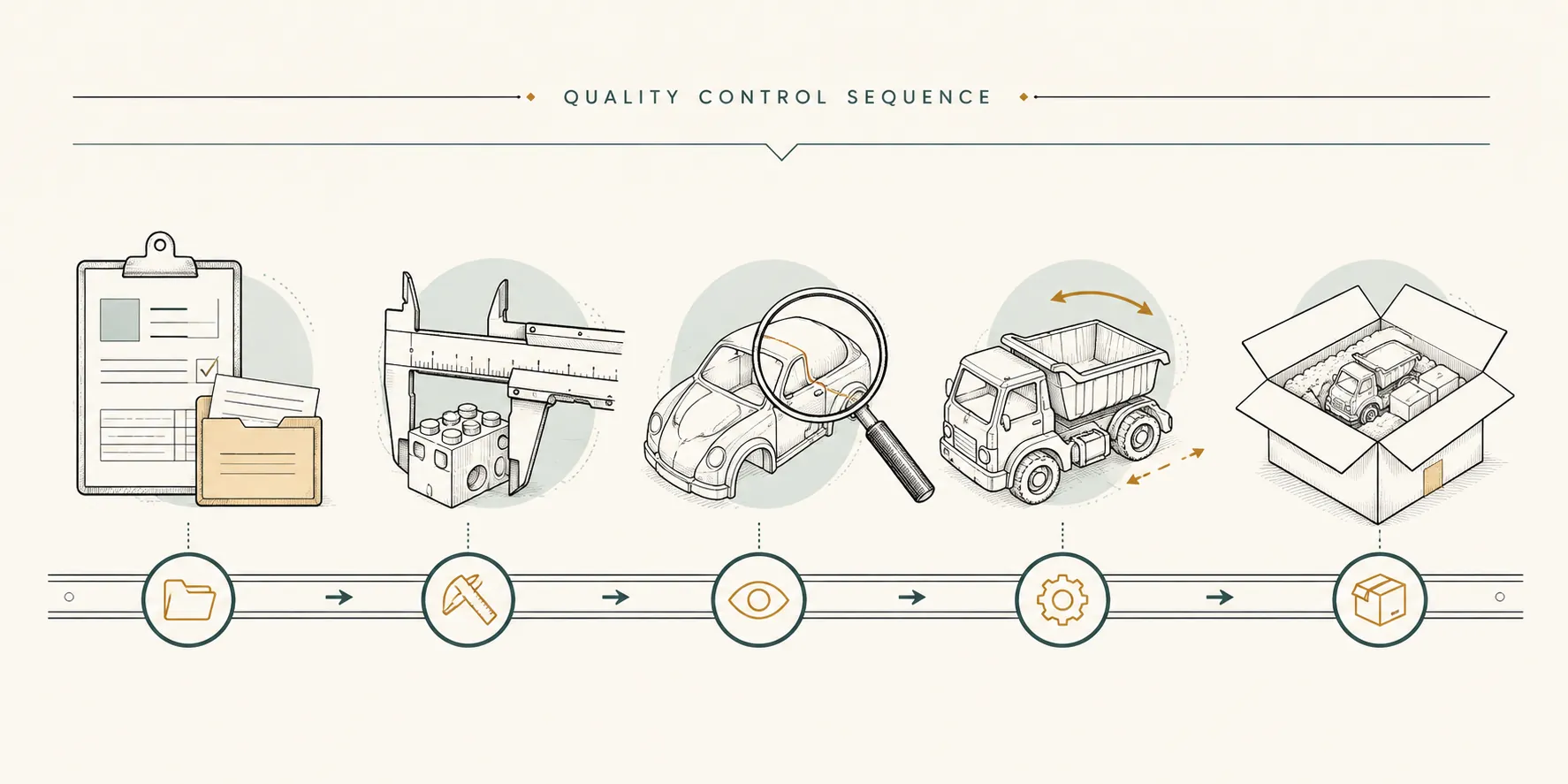
Do not rely on a single final inspection. Build three checkpoints into your order timeline. Checkpoint one: line clearance before the first run. Confirm the previous SKU's labels, colors, and work instructions are cleared from the line. Checkpoint two: in-line inspection during production. Check the button-cell compartment security, warning visibility, and label match on a sampling basis. Checkpoint three: pre-shipment inspection against your approved sample revision. If you are importing and cannot be at the factory, consider a third-party inspection. Ask the supplier for their AQL level and inspection standard — do not assume a default. A type-test report does not automatically cover a later production lot, so match the report to your specific PO.
How to Set Reorder Rules That Prevent Stockouts and Overstock
The best reorder rule is based on sell-through, not on 'do you have stock?' When your sales velocity is known, set a trigger. For example, reorder when you have sold about 60% of your current batch. That trigger must account for the supplier's lead time: if lead time is 30 days and you sell 100 units a week, you need to reorder when you have about 500 units left (5 weeks of stock). Use your own sales data, not the supplier's availability, to decide when to reorder. For seasonal products, align your reorder with the season's length. A party-favor seller might reorder every six to eight weeks during peak party season, while a container importer might buy in larger, less frequent batches to fill CBM. Track your ordering cost, unit cost, and holding cost quarterly to adjust when freight rates or demand change.
What Evidence Should You Collect Before Placing an Order?
Before you commit, collect the following evidence: a sample with a revision card, a written lead-time breakdown, a line-clearance log, a compliance test report (if required) that matches your SKU, and a written freeze date for any changes. Distinguish between verified facts and assumptions. For example, a supplier saying 'we have 200 staff and 11 production lines' is a fact you can check, but a claim that 'you will double your margin' is an assumption. Do not accept a single total lead time; ask for the breakdown. If a supplier cannot provide a revision card or a clearance log, that is a signal to proceed with caution. Keep all evidence in your order file so you can hold the supplier accountable.
FAQ
What MOQ should I expect for custom toy orders?
MOQs vary widely by product complexity and supplier. For standard plastic toys, some suppliers set MOQs around 12–96 units per SKU, while others require hundreds or thousands for custom molds. Ask the supplier for their per-SKU MOQ and whether they allow mixing products to reach a total minimum. Always calculate your EOQ to see if the MOQ fits your demand and cash flow.
How do I know if a toy supplier's lead time is realistic?
Ask for a breakdown that separates tooling, sampling, testing, production, packaging, and shipping. Confirm whether the quoted lead time includes peak-season buffers and what the freeze date is for changes. A lead time of 25–35 days can be realistic for a standard product, but add extra weeks during peak season. Get the freeze date and change-over hours in writing.
What should I check for button-cell toys before ordering?
Verify the battery compartment is secured with screws, requires a tool to open, and carries the required warning label. A child should not be able to open it with fingernails. In the US, you need a Children's Product Certificate (CPC) that lists the relevant rules. Ask the supplier for the compartment test report and warning label template, and confirm they meet the destination market's requirements.
How can I avoid mixed-label errors in a toy shipment?
Ask the supplier for their line-clearance procedure and a log showing the last three runs. A new SKU must not start until the previous SKU's labels, colors, and work instructions are cleared from the line. Specify in your PO that line clearance must be documented before production begins, and consider an in-line inspection to verify label match.
What is a good reorder point for seasonal toys?
Set your reorder point based on sell-through and lead time. For example, reorder when you have sold about 60% of your batch, and ensure you have enough stock to cover the lead time. For a 30-day lead time and sales of 100 units per week, you need at least 500 units on hand when you reorder. Adjust for season length and your supplier's lead time.
Do I need a third-party inspection for my toy order?
Not always, but it is wise for large or first orders. A third-party inspection can verify line clearance, check button-cell compartments, and confirm the shipment matches your approved sample revision. Ask the supplier for their AQL level and inspection standard, and decide based on your risk tolerance and the product's complexity.
Sources
Request a Quote
Ready to plan your next toy order? Use the questions in this guide to vet suppliers and get a clear MOQ and lead-time breakdown. If you need help, request a quote and our team will walk you through the process.